Introduction
Access Rights are granted to an individual under various data protection regimes. This right allows an individual to ask an organization whether their data is being processed, if yes then obtain a copy of that data, understand how and why their data is being used. However sometimes certain individuals like a disgruntled employee, a customer trying to extort money over litigation threats or a formal client involved in contractual dispute, may submit access requests to exert pressure, increase administrative burdens or gain some sort of leverage over an organization. Such requests are informally called as “Revenge DSAR”.
While these requests may appear retaliatory, an individual's motive alone does not necessarily make them invalid. This raises an important legal question:
When can an organisation lawfully refuse a data access request on the grounds that it is abusive, excessive, or made in bad faith?
Understanding the legal problem
The term Revenge DSAR (Data Subject Access Right) is an informal expression rather than a legally defined term. The law considers the concept of manifestly unfounded, excessive and abuse of rights . It is important for organisations to understand where the balance lies, every requester's involvement in litigation, hostile communications or dissatisfaction with an organisation does not necessarily establish that their request is abusive. At the same time access rights should not be used solely to manufacture legal violations or compensation claims. Therefore, organisations must establish two things:
- Motive behind a request: Whether the individual wants to access information, pursue litigation, exert pressure or seek compensation.
- Conduct a satisfying test to see if there are any statutory ground for restrictions: Whether there is any evidence to prove abuse, excessiveness or any other statutory basis for limiting access.
Legal threshold for refusing an abusive DSAR
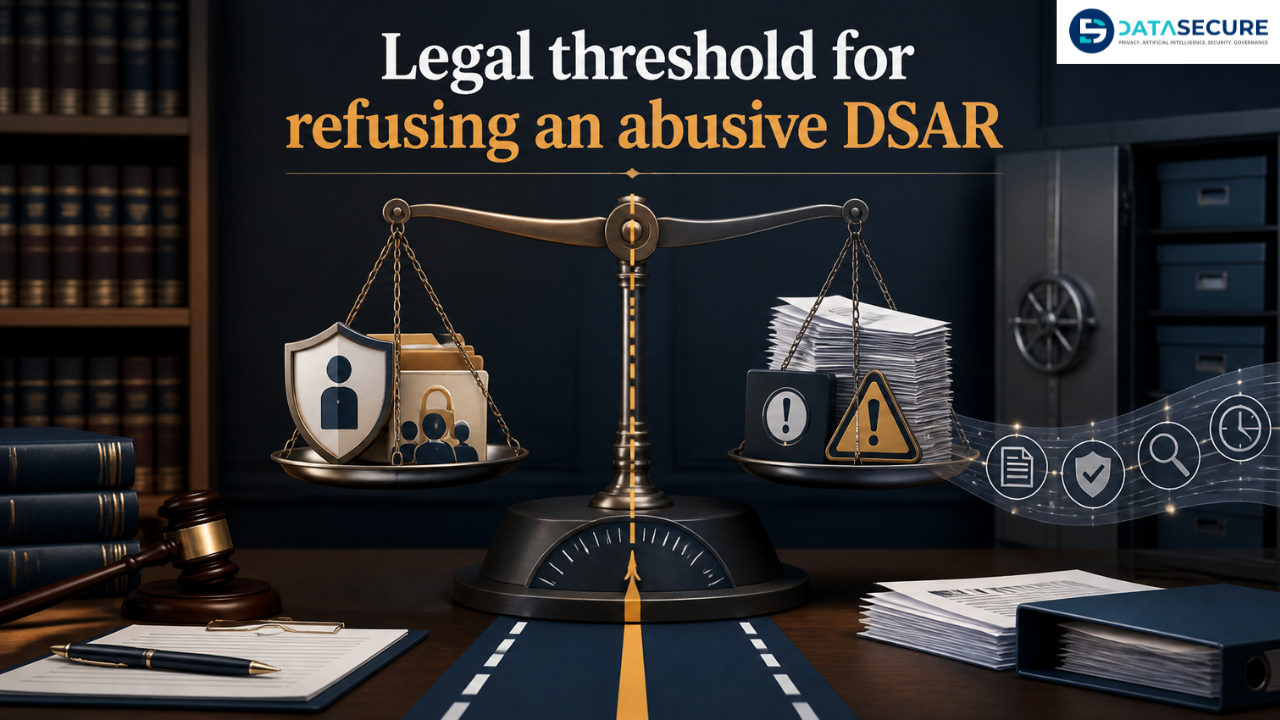
Data access rights exist across multiple jurisdictions, and their potential misuse is not limited to any one legal framework. This blog focuses on the GDPR because its statutory provisions, regulatory guidance and recent case laws offer clearer grounds for assessing and addressing abusive requests. To understand when an organisation can refuse a potentially abusive DSAR, it is important to first examine the scope of the right of access and the exceptions available under the GDPR.
Article 15 of the GDPR grants the individual the right to access personal data and specified information about its processing.
Under Article 12(3), states that it is the controller’s responsibility to respond to these requests within one month, with a possible extension of two months depending upon the complexity or the number of requests.
The right of access is not absolute. Article 12(5) establishes the exceptions. The article states that in cases where the request are found to be “manifestly unfounded or excessive”, particularly because of their repetitive character, controllers may either charge a reasonable administrative fee or refuse to act. However, the burden of demonstrating that requests threshold lies with the controller.
The interpretation of this exception becomes particularly important when dealing with suspected revenge DSARs. Two CJEU judgments help clarify the distinction between using a DSAR to obtain information for a legal claim and deliberately misusing the access request process to manufacture grounds for a compensation claim.
Case law: FT v DW (2023) (Case-C 307/22)
A patient had requested copies of his medical records to investigate a potential malpractice claim against his dentist. The dentist sought reimbursement for providing the records under German law, raising questions about the patient's entitlement to a free first copy under the GDPR.
The CJEU held that individuals are not required to justify their reasons for exercising their right of access and are generally entitled to a free first copy of their personal data, even when the information is sought for litigation purposes.
This lays down an important principle for the organisations handling suspected revenge DSARs i.e. ‘a request cannot be considered abusive merely because the individual intends to use the information in legal proceedings’. Organisations must note that any refusal must be supported by a recognised legal ground rather than assumptions about the requester's motives.
Case Law: Brillen Rottler v TC (2026) (Case C-526/24)
In this case an individual subscribed to an optician’s newsletter and submitted a DSAR request within 13 days of doing so. The optician company refused to honour that request alleging that the individual had repeatedly used similar tactics against other businesses to pursue GDPR compensation claims. The individual claimed a violation of GDPR and demanded 1000 Euros as compensation from the company.
The CJEU held that ‘even first-time access request can be considered excessive under article 12(5) GDPR if the affected organisation/company is able to successfully demonstrate that request is made with an abusive intention, such as artificially creating grounds for a compensation claim.’
This judgement was essential as it laid down the law for the fact that organisation need not entertain abusive requests merely because they are submitted for the first time. However, the burden to prove the abuse lies with the organisation and the exception must be applied restrictively. So, an organisation’s decision to reject a DSAR must be supported by evidence which proves that the request was intended to misuse GDPR rights than genuinely exercising them. The Court left the determination of whether the request in this particular case was abusive to the referring national court.
The key take away from both the cases is that a DSAR to support a legal claim is not, in itself, a reason for refusal. However, if an organisation can show that the request is being deliberately misused, it may have grounds to refuse it.
EDPB stance on abusive DSAR requests
The European Data Protection Board (EDPB)’ Guidelines 01/2022 on Right of Access provides guidance for organisations that deal with potentially retaliatory or revenge DSARs. EDPB states that the following actions can be considered excessive because of tis abusive conduct (refer para 190, page 58):
- An individual offering to withdraw an access request in exchange for a benefit from the organisation.
- Requests made maliciously with the sole intention of harassing the controller or its employees.
- An individual expressly stating that their intention is to cause disruption.
- Systematically submitting requests as part of a campaign intended to disrupt operations.
However, the EDPB also clarifies that a request should not be denied by the controller on the ground that (refer para 189, page 58):
- no reasons are given by the data subject for the request or the controller regards the request as meaningless;
- improper or impolite language is used by the data subject;
- the data subject intends to use the data to file further claims against the controller.
The burden of justifying a DSAR refusal lies with the organisation
In 2025 EDPB created a Coordinated Enforcement Action Report where it examined various organisations’ Right of Access compliance which involved 1,185 controllers across 30 supervisory authorities. The report highlights organisation being inept dealing with access request primarily due to inadequate internal procedures, excessive identity-verification requirements, and overly broad interpretations of exceptions used to refuse requests. Similarly, according to the CNIL's report on its 2024 enforcement actions, 16 decisions issued under its simplified sanction procedure concerned failures to comply with individuals' right of access.
The reason why organisation need to be extra cautious when dealing with revenge DSARs, as the risk is twofold: i.e. while proven abuse may justify refusal, an unjustified refusal can expose the organisation to complaints, regulatory action or litigation.
How should organisations deal with suspected revenge DSARs?
1. Establish a centralised DSAR management process
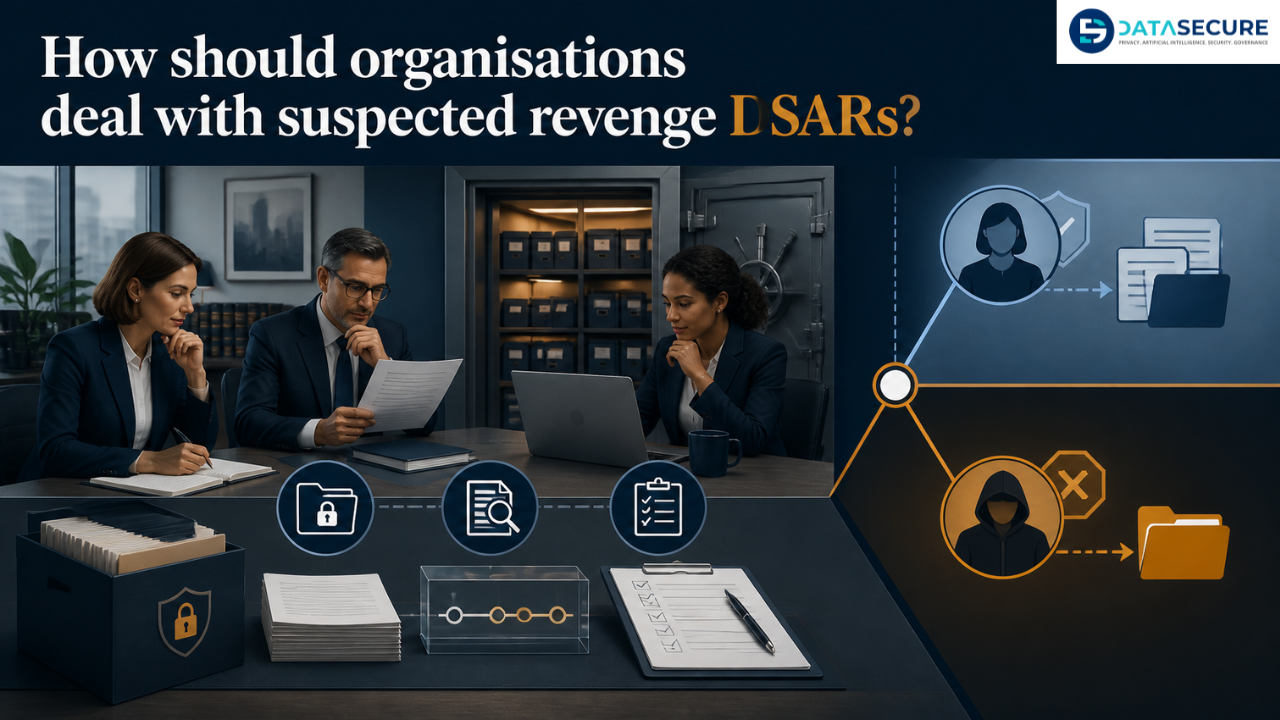
The most effective way to protect an organisation from abusive or revenge DSARs is to ensure that all the requests are recorded, tracked and handled through a consistent internal process. EDPB's 2025 Coordinated Enforcement Report, which examined 1,185 controllers across 30 supervisory authorities, identified the absence of documented internal procedures as a recurring compliance challenge. Organisations should have systems that are able to track and record receipt dates, regulatory deadlines, previous disclosures and any internal discussions at minimum for all the DSAR requests. These mechanisms come in handy to tackle the issue of multiple overlapping requests or allegations of organisation’s failure to respond.
2. Preserve evidence of potentially abusive conduct
When a request appears to deliberately disrupt the organisations natural functioning, such evidence must be preserved rather than rejecting it immediately.The evidence logs of the such requests should include previous requests, any expression of threats of disruptions, any information already supplied and any communications regarding financial demands. Following Brillen Rottler Case, such evidence can come in handy for not honouring the access request if such matter is brought forth before a supervisory authority or court.
3. Conduct targeted searches and apply relevant exemptions
A suspected revenge DSAR may seek internal correspondence containing personal information about employees, customers, witnesses or other individuals. Organisations should be able to identify relevant records, data systems and custodians of the particular personal information in question. EDPB guidelines also place emphasis, that controllers must ensure they can track PIIs in all relevant IT systems and non-IT filing systems, including data sets processed by their processors.
Once the data has been identified, organisation should evaluate whether specific information can lawfully be withheld because of applicable restrictions, third-party rights, or legal privilege under relevant EU or Member State law. Article 15(4) GDPR states that a right to obtain a copy of must not adversely affect the rights and freedoms of others. A well-designed disclosure review can protect the organisation’s legitimate interests without unnecessarily refusing the entire request.
4. Decide whether charging a fee or refusing the request is appropriate
Depending on the nature of the revenge DSAR an organisation may potentially have two possible responses as per Article 12(5), it can either charge a reasonable administrative fee or refuse to act. The EDPB guidelines state that controllers must assess the situation and take a decision based on the circumstances. For repetitive requests it is more appropriate to charge a fee because it addresses the additional administrative costs incurred. However, the fee must be reasonable and should be communicated to the Data subject before proceeding. For request which tend to demonstrate genuine abuse, refusal may be the more appropriate response.
5. Document and communicate any refusal
Whenever the organisation decides to refuse the DSAR, the decision must be backed by a documented legal assessment. The response must be communicated with reasons to the data subject without undue delay as per Article 12(4) GDPR along with this the controller must also inform the individual about the possibility of lodging a complaint with a supervisory authority and seeking a judicial remedy.
Internally a refusal record should identify the relevant statutory provision, supporting evidence, analysis of the alleged abuse and reasons for the selected response. With precedence set by the Brillen Rottler case it can be concluded that an evidence-supported refusal is substantially more defensible than a decision based merely on the requester's hostility or suspected motives.
Conclusion
Revenge DSARs can expose organisations to financial demands, operational disruptions and legal disputes. Even though data access rights are an essential part of privacy protection, organisations must be prepared to identify and address the cases which may constitute an abuse of those rights.
The most effective defence lies not in automatically refusing contentious requests, but in establishing a structured, evidence-based approach to managing them. This includes identifying potential abuse, maintaining proper documentation, applying relevant statutory restrictions and ensuring that decisions are supported by clear legal reasoning. The best way to mitigate these issues is by developing a robust internal DSAR handling procedure and proactive approach to request management, this enables the organisation to protect their interest, minimise compliance risk and respond confidently to potentially abusive requests while respecting individuals' lawful access rights.
We at Data Secure (Data Privacy Automation Solution) DATA SECURE - Data Privacy Automation Solution can help you to understand Privacy and Trust while lawfully processing the personal data and provide Privacy Training and Awareness sessions in order to increase the privacy quotient of the organisation.
We can design and implement RoPA, DPIA and PIA assessments for meeting compliance and mitigating risks as per the requirement of legal and regulatory frameworks on privacy regulations across the globe especially conforming to GDPR, UK DPA 2018, CCPA, India Digital Personal Data Protection Act 2023. For more details, kindly visit DPO India – Your outsourced DPO Partner in 2025 (dpo-india.com).
For any demo/presentation of solutions on Data Privacy and Privacy Management as per EU GDPR, CCPA, CPRA or India DPDP Act 2023 and Secure Email transmission, kindly write to us at info@datasecure.ind.in or dpo@dpo-india.com.
For downloading the various Global Privacy Laws kindly visit the Resources page of DPO India - Your Outsourced DPO Partner in 2025
We serve as a comprehensive resource on the Digital Personal Data Protection Act, 2023 (Digital Personal Data Protection Act 2023 & Draft DPDP Rules 2025), India's landmark legislation on digital personal data protection. It provides access to the full text of the Act, the Draft DPDP Rules 2025, and detailed breakdowns of each chapter, covering topics such as data fiduciary obligations, rights of data principals, and the establishment of the Data Protection Board of India. For more details, kindly visit DPDP Act 2023 – Digital Personal Data Protection Act 2023 & Draft DPDP Rules 2025
We provide in-depth solutions and content on AI Risk Assessment and compliance, privacy regulations, and emerging industry trends. Our goal is to establish a credible platform that keeps businesses and professionals informed while also paving the way for future services in AI and privacy assessments. To Know More, Kindly Visit – Your Trusted Partner in AI Risk Assessment and Privacy Compliance | AI-Nexus